
Accord and Satisfaction: How It Settles a Business Dispute

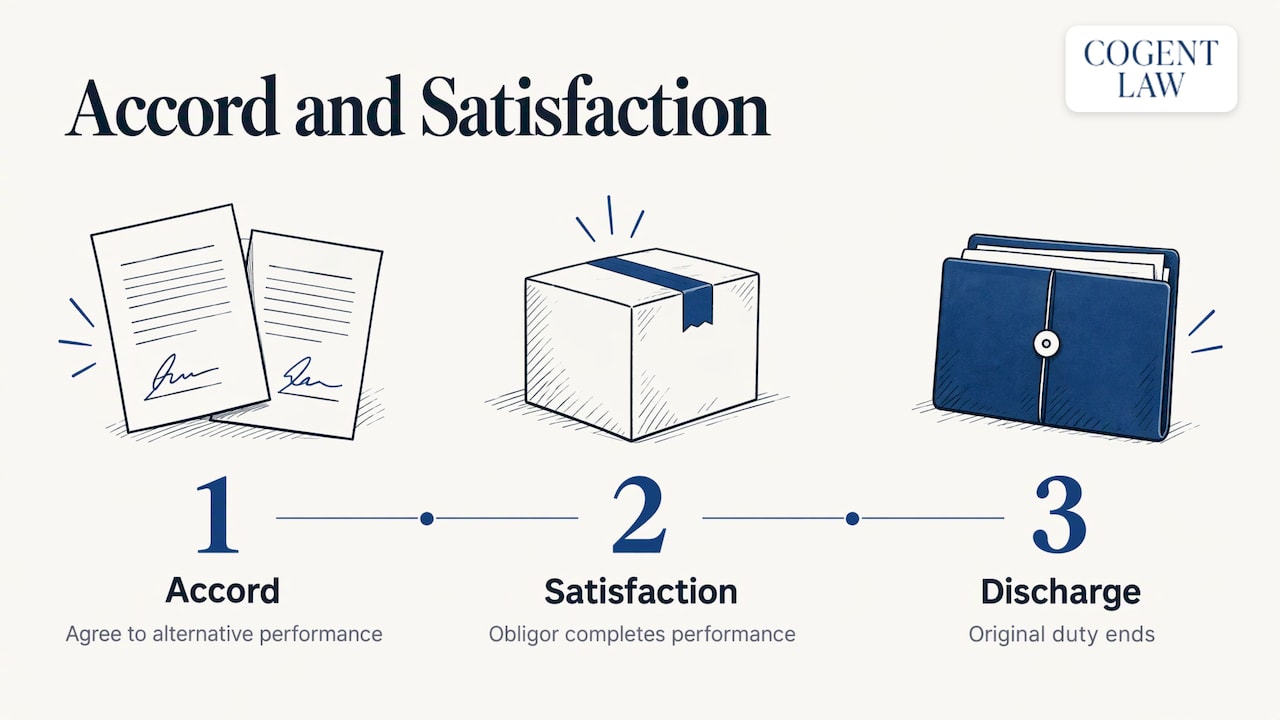
Accord and satisfaction is a way to end a contract claim or debt by agreeing to something different from what was originally owed, and then actually delivering it. The accord is the agreement. The satisfaction is the performance that follows. When both happen, the original obligation is discharged. When the paperwork, the dispute or the payment is handled loosely, the doctrine fails and the full claim can come back. Our attorneys work on commercial disputes for companies in regulated and emerging industries, and this is how we would explain it to a founder or a board.
TL;DR
- An accord is the agreement to accept different performance. Satisfaction is the completed performance. Under the general rule, the old duty is not discharged until the satisfaction happens.
- Paying less than an undisputed, fixed debt generally does not work. A real, good-faith dispute over the claim, or new consideration, is usually what makes it binding.
- A “payment in full” check can settle a claim under UCC § 3-311, but only if several conditions are met, and the creditor has a 90-day window to repay in some cases.
- State law varies. Check the rule in the state whose law governs your contract before you send or cash anything.
Table of Contents
- What accord and satisfaction means
- Why a smaller payment is not always enough
- Settling with a check: UCC § 3-311
- Receiving a full-satisfaction check
- When the accord is breached or disputed
- State differences that change the answer
- A checklist before you settle
- How Cogent Law can help
- FAQ
- Sources
What accord and satisfaction means
The doctrine has two parts, and keeping them apart prevents most mistakes.
The accord is a new agreement between the party owed (the obligee) and the party owing (the obligor). They agree that the obligor will give alternative performance, and the obligee will accept it, in place of the original duty.
The satisfaction is the obligor actually completing that alternative performance. Cornell’s legal encyclopedia describes it the same way and notes that the pre-existing duty is not discharged until performance occurs. California’s statute says the same: an accord does not extinguish the obligation until it is fully executed, and the creditor’s acceptance of the agreed consideration is the satisfaction.
In litigation, accord and satisfaction is an affirmative defense. That means the party who says the claim was settled must plead it and prove it. In Texas, for example, the treatise published by the State Bar states that it must be specifically pleaded and the burden sits with the party asserting it.
The doctrine is also not limited to contract debts. It can discharge a tort claim or other liability. For most operating companies, though, it comes up in three places: a vendor invoice you contest, a customer who disputes a bill, and a settlement of a larger claim.
Why a smaller payment is not always enough
A new agreement needs consideration, meaning something of legal value exchanged by each side. The old common-law rule is that paying part of a debt you already clearly owe is not consideration. You were already obligated to pay it.
Professor Scott Burnham’s primer on the doctrine gives the classic contrast. If a $1,000 debt is fixed and undisputed, a creditor who accepts $800 can still pursue the other $200. If the obligation is disputed or the amount is uncertain, the settlement itself supplies consideration: accepting $500 in full satisfaction of a disputed $600 bill discharges it.
Two terms matter here:
- Liquidated means the amount is fixed or easily calculated from the contract, such as a loan balance.
- Unliquidated means the amount is genuinely uncertain, such as damages for defective work.
Change the performance, not only the amount
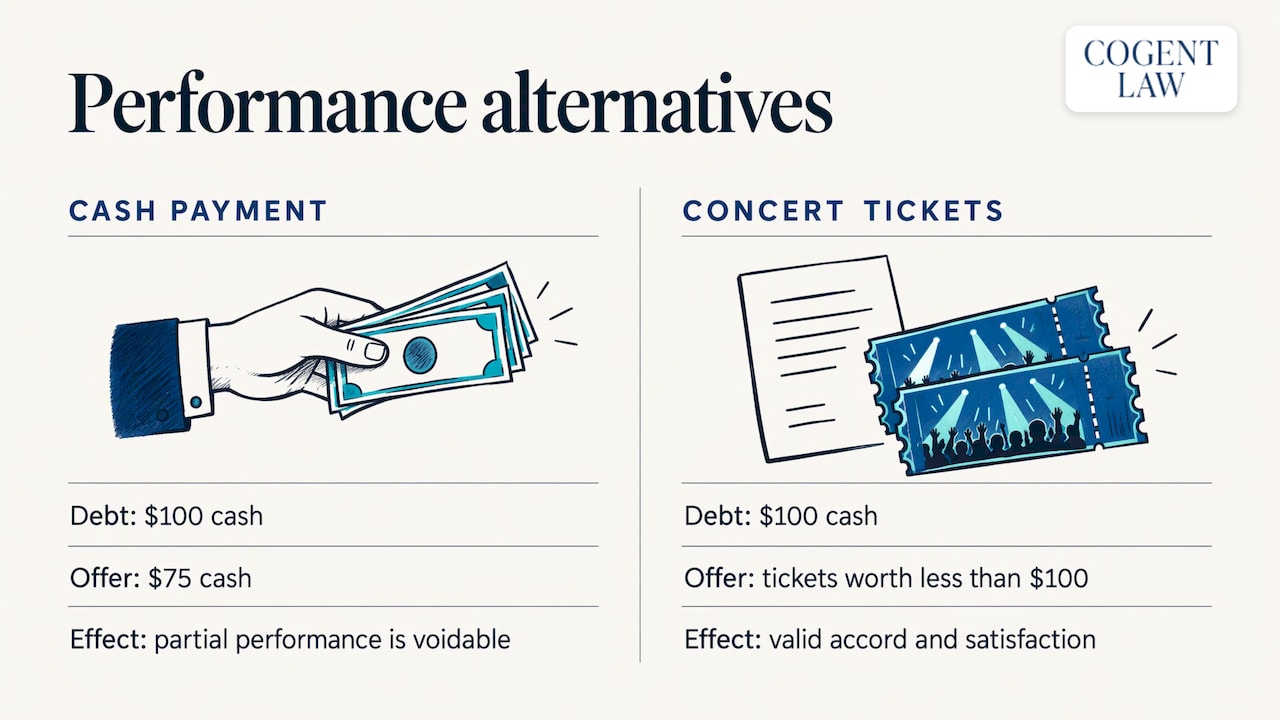
The alternative performance must differ in some way. Cornell’s entry gives an example: an agreement to pay $75 cash on a $100 cash debt is voidable as mere partial performance, while accepting concert tickets worth less than $100 is a valid accord and satisfaction, because the tickets are new consideration.
Courts in some states are generous about what counts. The New Mexico Supreme Court in Western Bank of Santa Fe v. Biava quoted the rule that any new consideration, however slight, generally suffices, and held that transferring a partnership interest plus giving up a right to a resale surplus could support an accord on a $66,005.24 note. Practical lesson: when a debt is clear, a settlement is more durable if it includes something new, such as a different asset, an earlier date, or a release of a separate claim.
The dispute has to be real
Where the amount is not the only variable, you need a bona fide dispute, meaning a good-faith disagreement about the claim itself. Courts police this.
- In Texas, the dispute must concern the claim itself, and the creditor must receive an unmistakable communication that taking the reduced sum satisfies the obligation.
- In Georgia, the annotations to § 13-4-101 say that settling a debt for a smaller sum with nothing else requires a bona fide dispute, and that the debtor’s good faith is a fact question for the jury.
- In South Dakota’s 2025 decision in Berwald v. Stan’s, the court reasoned that the dispute must exist between the parties, not only in the mind of the check’s sender, and that an arbitrary refusal to perform cannot manufacture one.
A useful internal test: could you explain, in writing, why you believe you owe less, without mentioning that you would like to pay less? If not, the dispute may not survive scrutiny.
Settling with a check: UCC § 3-311
The most common business version is the “full satisfaction” check. Most states have adopted the Uniform Commercial Code’s Article 3, and UCC § 3-311 says a claim is discharged if the debtor proves all of the following:
- The debtor tendered the check in good faith as full satisfaction of the claim.
- The claim was unliquidated or subject to a bona fide dispute.
- The creditor obtained payment of the instrument.
- The check, or an accompanying written communication, contained a conspicuous statement that it was tendered in full satisfaction.
There are two important exceptions in subsection ©. The claim is not discharged if the creditor is an organization that had told the debtor, in a conspicuous statement, to send disputed-debt communications to a particular person, office or place, and the check went elsewhere. And the claim is not discharged if the creditor tenders repayment of the amount within 90 days after payment. Under subsection (d), however, the claim is discharged anyway if the creditor or a responsible agent knew of the full-satisfaction tender before collection began.
A worked example
Your software vendor invoices $60,000 for an integration. You believe the work was only partly delivered and dispute $20,000 in writing. You send a $40,000 check with a cover letter stating that it is tendered in full and final satisfaction of the invoice, and the vendor deposits it. If the dispute is genuine and the vendor did not repay within 90 days, the debt is likely discharged. If the invoice had been undisputed, the same check would probably leave the $20,000 owed.
What courts have done with these checks
- In Berwald, the South Dakota Supreme Court affirmed that a $6,921.57 check sent with a letter to satisfy all obligations between the parties discharged the breach-of-contract claim.
- In the New Hampshire case DeCato Bros. v. Westinghouse Credit Corp., a $271,433.92 payoff check marked “payment in full” and accepted by the lender was held to be classic accord and satisfaction.
- In a 2026 New York appellate decision, Vega v. Navy Federal Credit Union, writing “payment in full” on money orders did not work because the mortgage debt was liquidated and not genuinely disputed.
- An Indiana appellate case summarized in the Indiana Law Review’s banking survey reached the same result for a $200 check sent on a $9,000 undisputed installment loan.
Note also that § 3-311 covers negotiable instruments only. Cornell’s entry on payment in full explains that wires, ACH and cash are generally governed by the common-law doctrine, and that writing “payment in full” on a check does not alone discharge the balance.
Receiving a full-satisfaction check
The creditor’s side deserves equal attention, because cashing a check can end a claim.
- Route disputed-debt communications to a designated person or address and say so conspicuously, which preserves the subsection © exception.
- Have whoever opens mail and deposits checks look for notations and cover letters.
- Calendar the 90-day repayment window the day a questionable check clears.
- Do not assume a protest on the endorsement saves you. In South Dakota, words of protest do not prevent accord and satisfaction under the common law, and the state’s version of UCC § 1-308 says reservation of rights does not apply to it.
California shows how much state detail matters. Its Civil Code § 1526 lets a creditor avoid the effect of a “payment in full” check by striking out the notation. But in Woolridge v. J.F.L. Electric, the court held the later-enacted Commercial Code section controls where they conflict, and that writing “partial payment” next to the endorsement did not satisfy the opt-out anyway. Rules like this are why a creditor should not rely on a clever endorsement.
When the accord is breached or disputed
An accord is only a promise until it is performed. Under Burnham’s primer, if the accord is breached, the injured party can sue on the accord or on the revived original obligation, and partial performance is credited as payment on account. The Texas treatise likewise says an accord without complete satisfaction does not bar a suit on the original claim.
So a settlement that stretches payments over twelve months is not a discharge on day one. If your counterparty misses the eighth installment, you may have a choice of remedies. If you are the payer, you have not won until the last payment clears.
Two more points on timing and form:
- A third party can perform. New Mexico’s civil jury instruction 13-836, amended in October 2025 and effective for cases pending or filed on or after December 31, 2025, says an obligor is excused if the obligor or a third party offered or performed and the obligee accepted something in full satisfaction.
- Parties can shape the effect by contract. The Texas authors note that Tex. Bus. & Com. Code § 1.302 allows variation of the doctrine’s effect by agreement.
State differences that change the answer
The core idea is consistent, but the details are not.
| Issue | Example of state variation |
|---|---|
| Elements | New Hampshire lists four elements: proper subject matter, competent parties, meeting of the minds and consideration |
| Undisputed claims | Georgia says liquidated or unliquidated, disputed or undisputed claims can be settled if supported by consideration |
| Executory accord | New Mexico treats an executory accord as a defense, even before satisfaction, for unliquidated claims or with new consideration |
| Check opt-out | California’s § 1526 conflicts with its UCC; the Commercial Code controls |
The Indiana Law Review survey notes that before revised Article 3, courts were divided on whether cashing a full-satisfaction check meant accepting the offer, and that § 3-311 codified the common-law rule with modest variations for modern business. The Texas authors describe the statute as meant to encourage informal resolution through full-satisfaction checks.
A checklist before you settle
- Write down the dispute. Describe the disagreement over the claim itself, with dates and documents.
- Say what the payment is for. State in a conspicuous way that the tender is in full satisfaction, and send it where the creditor has said disputes go.
- Add something new where the debt is clear. A different form of performance, a release, or an earlier date strengthens consideration.
- Get a signed settlement agreement. Include a release, the performance schedule, and what happens on default.
- Track performance. The discharge arrives with the satisfaction, not with the signature.
- Confirm the governing law. Check the contract’s choice-of-law clause and the state’s version of the statutes above.
How Cogent Law can help
These disputes tend to arrive when a company is already busy: a vendor fight during a financing, a customer dispute before an acquisition, a settlement with a counterparty that shapes your diligence file. Our litigation and dispute resolution team handles commercial disputes for companies in regulated and emerging industries, and we offer upfront budgets and estimates and fixed-fee and hybrid arrangements.

If you are deciding whether to send or accept a full-satisfaction payment, or drafting a settlement that has to hold up, see our practice areas and talk to an attorney before the check goes out.
FAQ
Is accord and satisfaction the same as a settlement agreement?
Not exactly. A settlement agreement is the document. Accord and satisfaction is the legal doctrine under which a settlement discharges the original obligation once the agreed performance is completed. A well-drafted settlement is built to satisfy that doctrine.
Does writing “paid in full” on a check settle a debt?
Not by itself. Under UCC § 3-311, the claim must be unliquidated or in bona fide dispute, the tender must be in good faith with a conspicuous full-satisfaction statement, and the creditor must obtain payment. Undisputed, fixed debts generally stay owed.
Can a creditor undo it after cashing the check?
Sometimes. Under § 3-311©, a creditor can avoid discharge by repaying the amount within 90 days, or if the check did not go to a designated place for disputes. The exception for creditors who knew of the tender before collecting can defeat this.
Who has to prove accord and satisfaction?
The party relying on it. It is an affirmative defense, so it must be pleaded, and the burden of proof rests with that party.
Sources
- Accord and satisfaction, Cornell Legal Information Institute
- Payment in full, Cornell Legal Information Institute
- UCC § 3-311, Cornell Legal Information Institute
- California Civil Code, Division 3, Part 1, Title 4
- California Civil Code § 1526
- Woolridge v. J.F.L. Electric, Inc.
- Georgia Code § 13-4-101
- New Mexico UJI 13-836
- Western Bank of Santa Fe v. Biava
- DeCato Bros. v. Westinghouse Credit Corp.
- Berwald v. Stan’s, Inc.
- Vega v. Navy Federal Credit Union
- A Primer on Accord and Satisfaction, Montana Law Review
- Texas Civil Practice, State Bar of Texas
- Indiana Law Review banking survey