
Commercial Contract Lawyer: What One Does and When to Hire

A commercial contract lawyer, also called a business contract attorney, drafts, reviews and negotiates the agreements your company runs on, and steps in when one of them is breached. For a high-growth company in a regulated industry, the best time to hire one is before the first signature, because the contract is where licensing duties, risk and control over the relationship get fixed. At Cogent Law, our attorneys bring large-firm and in-house experience to this work and offer upfront budgets and estimates, so you know what an engagement will cost before it starts.
TL;DR
- A contract lawyer does more than proofread. Counsel structures the deal, negotiates terms and drafts the agreement so that it allocates risk the way your business needs.
- Bring counsel in before signing. Fixing a vague clause during a dispute costs far more than drafting it correctly.
- Regulated companies have an extra layer: licensing, oversight and approval requirements can change what a contract must say.
- Contract law varies by state, and the rules differ again for goods and for services, so a lawyer familiar with your state and industry matters.
- Ask for a budget, a fee structure and a scope in writing. Fixed-fee and hybrid arrangements are available for defined contract work.
Table of Contents
- What a commercial contract lawyer actually does
- Which contracts to have a lawyer handle
- When to bring counsel in
- How a lawyer finds contract risk in a regulated business
- Contract rules differ by state
- What affects the cost, and how fees are structured
- How to prepare for the engagement
- How Cogent Law helps
- FAQ
- Sources
What a commercial contract lawyer actually does
According to the New York City Bar, a business and corporate attorney helps companies draft, review and negotiate contracts that are clear, enforceable and aligned with strategic goals. The same lawyer advises on interpretation, compliance and enforcement, finds gaps in existing agreements, and represents the company if a dispute reaches litigation.
The American Bar Association’s contract drafting treatise describes the transactional lawyer’s job in three words: control, standards and risk. Control means shaping how the parties interact in the future. Standards means setting measurable requirements for performance. Risk means making sure your company takes on only as much of it as the deal’s benefits justify.
That is a different discipline from litigation. In a lawsuit one side wins. In a deal, both sides want the transaction to close, and your lawyer has to press your interests without scuttling it. Georgetown Law’s guide to transactional careers notes that this requires assessing each party’s negotiating leverage and engaging the counterparty in a way that advances your position.
Why drafting is a specialty
The ABA treatise points out that drafting is a core skill almost every lawyer needs, yet few have formal training in it as a distinct discipline. Many simply mark up old contracts and keep habitual language. It also makes a point founders rarely hear: most contract litigation is about interpreting the provisions the lawyer wrote. A clause a court finds ambiguous has failed at its one job.
The treatise lists accuracy and clarity first among the marks of good drafting. Accuracy means the contract reflects the whole agreement, with correct names, numbers and dates. Clarity means each provision can be read only one reasonable way, the one both sides intended. Those are the details that decide whether you can enforce a term eighteen months later.
Which contracts to have a lawyer handle
The NYC Bar lists the everyday agreements a business attorney works on:
- Vendor and service contracts
- Partnership and shareholder agreements
- Employment and independent contractor agreements
- Commercial leases
- Confidentiality and non-disclosure agreements
The Georgetown guide extends the field to capital raises and securities issuances, mergers, acquisitions and divestitures, joint ventures, bank and project financings, and restructurings, along with the regulatory advice that goes with them. Day-to-day work includes negotiating with counterparties, advising on governance, creating legal entities, filing required forms and conducting due diligence.
A simple way to prioritize
Not every agreement needs the same attention. A practical sorting rule for a growing company:
- Agreements that define the company itself. Founder, shareholder and investor documents, and anything tied to a financing or sale. Our corporate law practice covers formation, governance and M&A.
- Agreements your revenue depends on. Customer contracts, distribution deals, bank and payment-partner arrangements, and key vendor terms.
- Agreements that carry regulatory weight. Anything touching a license, a banking relationship or a regulator’s oversight.
- Routine paper. Standard NDAs and low-value purchase terms, which can follow a template your lawyer has already built for you.
The fourth tier is where a good attorney saves you money: one well-built template, reviewed once, can serve many deals. If you are still deciding what legal support to put in place at an early stage, our guide on what startup legal counsel to hire and when lays out the sequence.
When to bring counsel in
The short answer is before you sign, and before the term sheet hardens into positions neither side wants to move from. The NYC Bar describes counsel’s work in two modes. Proactively, a lawyer identifies gaps or vulnerabilities in existing agreements and recommends updates as the company grows or as laws and market conditions change. Reactively, counsel evaluates your rights and remedies when a dispute arises and tries to resolve it through negotiation or alternative dispute resolution before litigation.
If you are already in a dispute, the NYC Bar says counsel helps assess risk, preserve key evidence and plan strategy, and pursues negotiation, mediation or arbitration where appropriate. Pleadings, motions, discovery and trial or appeal follow only when litigation cannot be avoided. Preserving evidence early is one reason to call a lawyer at the first sign of a breach rather than after the relationship has collapsed.
Moments that should trigger a call
- A counterparty sends its own paper and says it is standard.
- A deal involves a new state, a new product or a new regulator.
- A contract auto-renews, limits your liability, or restricts who you can sell to.
- A partner misses a deadline or payment and you are unsure of your options.
- You are about to raise capital, sign a bank agreement or enter a sale process.
Because dispute-resolution clauses decide where and how a future fight happens, they deserve attention at signing. Our overview of arbitration agreements for businesses explains the trade-offs.
How a lawyer finds contract risk in a regulated business
The New York State Bar Association explains that outside general counsel advise on compliance with the laws, regulations and industry standards that apply to a client’s operations, including employment law, data privacy and financial reporting. By understanding how the business runs, they identify legal risks early and put policies and contracts in place to reduce them.
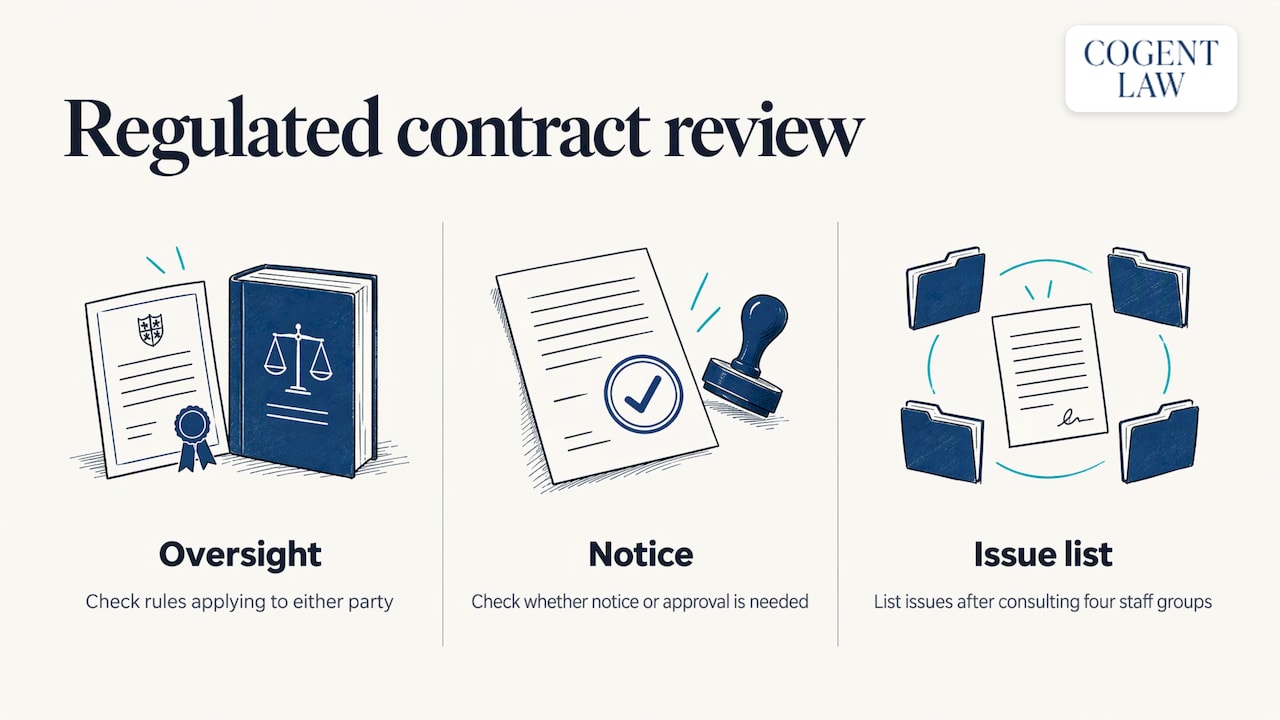
For regulated companies the same source’s drafting checklist tradition points to specific questions: Do licensing or oversight rules apply to either party? Does the transaction need a notice or an approval? The checklist also recommends building a list of transaction issues after talking with business, legal, contract-management and compliance staff. A contract that ignores these questions can be perfectly written and still unusable.
The Georgetown guide gives an example of drafting that anticipates risk. A Davis Polk attorney updated force majeure and material adverse change terms in a private equity firm’s agreement to buy Victoria’s Secret, making it harder for the buyer to back out because of pandemic-related disruption. The lesson for any company: boilerplate such as notice, assignment and governing law is still negotiable, and the specific risks of your deal belong in the major terms.
What this looks like in our industries
For fintech, blockchain, cannabis, life sciences, energy and financial services companies, the contract often sits next to a license, a banking relationship or a regulatory filing. Our attorneys work across those areas, including money transmitter licensing, regulatory and AML compliance, and cannabis and hemp banking, so contract terms can be drafted with the compliance picture in view rather than reviewed in isolation.
Contract rules differ by state
There is no single American contract code. Contract law is made largely by the states, and your governing-law clause chooses which state’s rules apply. One example of a shared framework: Article 2 of the Uniform Commercial Code governs the sale of goods and was approved in 1951. A revised Article 2 approved in 2003 was not adopted by any state and was withdrawn in 2011. So a contract for products and a contract for services can follow different rules, and the state’s version of the code applies to the first.
Other areas where state law shapes the agreement include:
- Employment and independent contractor terms
- Restrictions on competition after a relationship ends
- Licensing requirements for the parties
- Required form of fee agreements with your own lawyer
Since these rules change, your lawyer should confirm the current position in each relevant state at the time of signing rather than reusing last year’s form. A multi-state company is better served by one counsel team that tracks the differences than by a new lawyer per state with no view of the whole.
What affects the cost, and how fees are structured
The fee depends on the complexity of the deal, how much negotiation it needs, the lawyer’s experience and how fast you need it. Texas’s disciplinary rules, discussed in State Bar of Texas CLE materials, judge fees by factors such as time and labor required, novelty and difficulty, local customary fees, the amount involved and results obtained, time limits, the length of the relationship and the lawyer’s experience and reputation. They also say that when a lawyer has not regularly represented you, the basis or rate of the fee should be communicated, preferably in writing, at the start.
California goes further. Under Business and Professions Code Section 6148, a written fee agreement is required when it is reasonably foreseeable that total expense, including attorneys’ fees, will exceed $1,000. It must state the basis of compensation, the general nature of the services and each side’s responsibilities.
Whichever state you are in, ask for the same three things in writing: the scope, the fee basis and an estimate. Cogent Law works on hourly, fixed-fee and hybrid arrangements and provides upfront budgets and estimates. We do not publish rates, because the right structure depends on the work: a defined contract review suits a fixed fee, while a negotiation with an uncertain length may suit a hybrid.
How to prepare for the engagement
Preparation shortens the engagement and sharpens the advice. Guidance in ABA Law Practice Magazine for choosing outside counsel says to assemble an internal team of stakeholders, define goals and give the firm company background, the type and volume of work, geography, typical cycle times, gaps in internal processes and pain points. Once counsel is chosen, agree on how you will communicate: how often, in what format and with what level of detail.
For a single contract, bring:
- The business goal in a sentence: what should this agreement let you do, and what must it prevent?
- Any term sheet, email thread or prior agreement with the counterparty.
- Your non-negotiables and the points where you can give ground.
- Licenses, approvals or bank requirements that touch the deal.
- The deadline, and who has authority to sign.
The NYSBA notes that a lasting relationship lets the attorney learn the business’s goals and typical needs, so issues get handled efficiently and with the whole organization in mind rather than one matter at a time. That is the practical case for one counsel relationship over a string of one-off reviews.
How Cogent Law helps
We advise companies in regulated and emerging industries on contracts alongside the corporate, regulatory and transactional work around them. Our attorneys have large-firm and in-house experience, we give upfront budgets and estimates, and we offer fixed-fee and hybrid arrangements as well as hourly billing. We can also connect clients with banks, investors, advisors and strategic partners. You can see the full list of areas on our practice areas page.

If you have an agreement to negotiate, a counterparty’s draft to review or a dispute taking shape, start with our corporate and M&A team.
FAQ
Is a commercial contract lawyer the same as a business contract attorney?
In practice, yes. Both terms describe a lawyer who drafts, reviews and negotiates business agreements and advises on enforcing them. Some also handle disputes when a contract is breached, which is where contract work and litigation overlap.
Should I hire a lawyer before or after a contract is breached?
Before, if you can. Counsel can close gaps and set clear remedies at signing. If a breach has already happened, call a lawyer early so your rights are evaluated and evidence is preserved before positions harden.
What should I bring to the first meeting?
Bring the draft or existing agreement, related emails or term sheets, your goals and deadline, and any licenses or approvals involved. Be ready to say which terms you cannot give up.
Can a contract lawyer work for a flat fee?
Often, for defined work such as reviewing or drafting a specific agreement. At Cogent Law we offer fixed-fee and hybrid arrangements as well as hourly billing, with an upfront budget or estimate. Complex negotiations or disputes may suit a hybrid structure better.
Sources
- New York City Bar: Business and Corporate Law
- American Bar Association: Contract Drafting
- Georgetown Law: Careers in Transactional Law (2021)
- NYSBA: Outside general counsel
- Uniform Law Commission: Uniform Commercial Code
- State Bar of Texas CLE: Fee agreements
- State Bar of California: Business and Professions Code Section 6148
- ABA Law Practice Magazine: Relationships with Outside Counsel