
Cybersecurity Compliance for U.S. Businesses: What Applies
Cybersecurity compliance means meeting the laws, regulations, contract terms and standards that govern how your company protects information. There is no single U.S. statute that covers every business. Your obligations depend on your industry, the data you hold, who your customers are and whether you are a public company. The fastest way to a defensible program is to map those obligations first, then build controls against a framework. That mapping is a legal question before it is a technical one, and it is where counsel who understands regulated industries saves a growing company the most time and rework.
TL;DR
- Compliance and security are not the same thing: compliance is the legal and contractual floor, and risk-based controls sit on top of it.
- U.S. obligations come from federal, state, local and tribal governments, industry mandates, contracts and voluntary standards, so the first job is working out which ones reach you.
- Public companies face SEC disclosure duties, and defense contractors face phased CMMC requirements in new contracts.
- A framework such as NIST CSF 2.0 turns the work into a repeatable cycle: scope, profile, find gaps, assign owners, repeat.
- Regulated and fast-growing companies get the most from legal counsel that scopes obligations early and prices the work up front.
Table of Contents
- Compliance and security are two different things
- Where U.S. cybersecurity obligations come from
- Rules that already have dates attached
- A framework turns obligations into a program
- How to tell which obligations apply to you
- Incidents: where compliance gets tested
- Why legal counsel belongs in the program early
- How Cogent Law helps
- FAQ
- Sources
Compliance and security are two different things
Security is what you do to protect systems and data. Compliance is proof that you meet the rules that apply to you. ISACA describes compliance as adhering to industry regulations, standards and laws on information security and data privacy. It gives you a foundation, but it does not by itself guarantee that an organization is secure. ISACA’s advice is to add risk-based controls tailored to your industry, your information and your threat landscape.
For a founder or board, this distinction decides where the money goes. A checklist that satisfies an auditor can still leave your most valuable data exposed. A strong technical program can still fail a regulator’s request for documentation. You need both, and you need to know which obligations are legally binding and which are good practice.
Where U.S. cybersecurity obligations come from
The United States has no single national cybersecurity law for private companies. NIST’s guidance for manufacturers explains that obligations can come from federal, state, local or tribal governments, from industry mandates and from voluntary standards. It names DFARS contract clauses and NIST CSF 2.0 as examples. In practice you will usually be answering to several layers at once:
- Sector regulators. Financial services, healthcare, energy and other regulated industries each have their own supervisors and rules.
- Securities law. Public companies owe the SEC specific cybersecurity disclosures.
- State law. States set their own requirements for data security and breach notice, so a company serving customers nationwide can face many of them.
- Contracts. Government contracts, bank partnerships and enterprise customers often push requirements down to you through the agreement itself.
- Voluntary frameworks. These are not law, but regulators, insurers and counterparties treat them as a benchmark of reasonable care.
For companies in the industries we serve, such as fintech, crypto, banking and financial services, cannabis and hemp banking, life sciences and energy, this stack is dense. A licensed money transmitter, for example, answers to state regulators and federal anti-money-laundering rules at the same time as it answers to its bank partners. Information security expectations flow through all of those relationships.
Rules that already have dates attached
Two regimes show how concrete the obligations get and how they arrive in phases.
SEC cybersecurity disclosure for public companies
The SEC’s small business compliance guide says the cybersecurity disclosure rules apply to Exchange Act reporting companies. That covers domestic registrants, foreign private issuers and business development companies. Two duties follow.
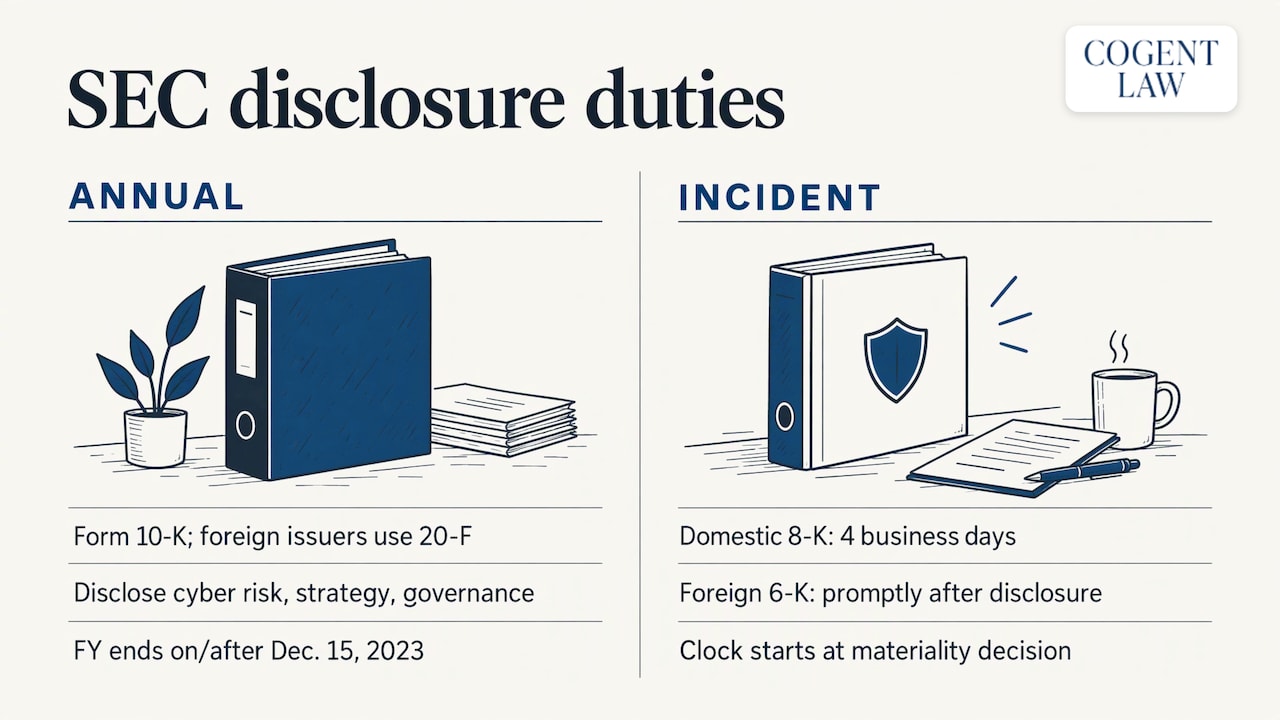
Annual disclosure. Registrants describe their cybersecurity risk management, strategy and governance in Form 10-K, or Form 20-F for foreign private issuers. That includes the board’s oversight of cyber risk and management’s role in assessing and managing it. The requirement began with fiscal years ending on or after December 15, 2023.
Incident disclosure. Domestic registrants file Form 8-K within four business days of determining that an incident is material. Foreign private issuers furnish Form 6-K promptly after the specified public disclosure. The SEC says the materiality decision must be made without unreasonable delay, and it can weigh quantitative and qualitative factors from the perspective of a reasonable investor. Incident disclosure began December 18, 2023 for registrants other than smaller reporting companies, and June 15, 2024 for smaller reporting companies.
The practical lesson for a board: the four-business-day clock starts at the materiality determination, not at the intrusion. A company that has no process for making that call quickly, with the facts and the right advisers in the room, is exposed. Companies heading toward an IPO or a reverse merger should build this governance before they are filing, not after.
CMMC for defense contractors
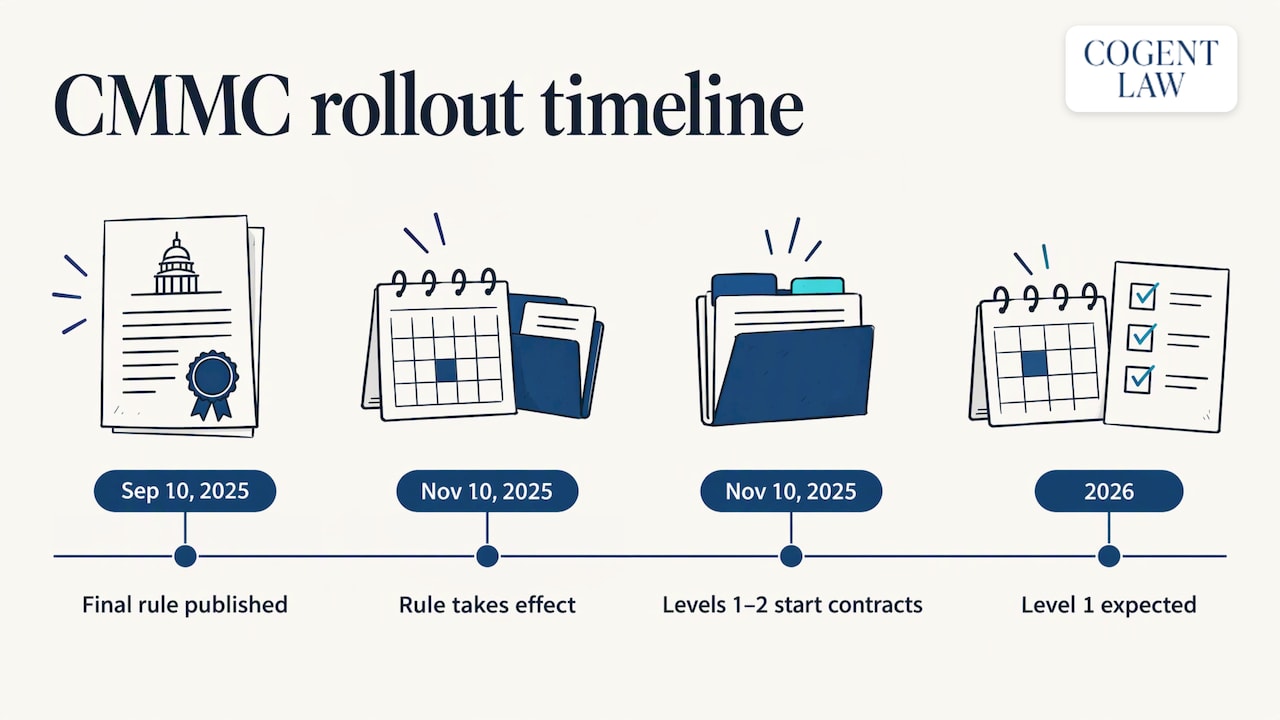
If you sell into the defense supply chain, cybersecurity requirements arrive through contracts. NIST notes that manufacturers in that chain may face DFARS requirements, with at least Level 1 CMMC expected by 2026 and at least Level 3 for entities handling DoD controlled unclassified information.
The Department of Defense’s CMMC resource page gives the timeline. The final DFARS CMMC rule was published September 10, 2025 and took effect November 10, 2025, beginning a three-year phased introduction into DoD contracts. Level 1 and 2 requirements enter new contracts in the initial phase starting November 10, 2025. Contractors are expected to self-assess and submit scores in SPRS, the DoD’s Supplier Performance Risk System, as applicable.
What this means for a growing company: a CMMC obligation can appear in a single contract clause and then flow down to your subcontractors. Reading those clauses before you sign is cheaper than discovering them at kickoff. Companies that need a way to budget the compliance work alongside everything else can use small business finance templates to track the cost of controls, assessments and legal support against cash flow.
A framework turns obligations into a program
Once you know what applies, a framework gives the work a structure. NIST’s Cybersecurity Framework (CSF) 2.0 is the most widely used. In its guide for non-employer small businesses, NIST describes CSF 2.0 as useful to firms of varying sizes, subject to their sector, resources, and contractual and regulatory requirements. The framework treats cybersecurity as an enterprise risk-management cycle. Governance sets expectations and policy, and the other five functions handle risk from identification through recovery.
A framework is not a legal safe harbor. It is a way to show that your program is organized, risk-based and documented, which is what regulators and counterparties look for. It also gives your legal, technical and finance teams a shared vocabulary.
A working sequence
The Defense Counterintelligence and Security Agency publishes a CSF checklist that treats compliance as an ongoing cycle rather than a one-time audit. Adapted for a growth-stage company, the steps look like this.
- Scope the organization. Decide which entities, systems, data types and business lines are in the program. Where it goes wrong: leaving out a new subsidiary, a vendor-hosted system or a product line added last quarter.
- Gather existing policies and risk information. Collect what you already have: security policies, vendor contracts, prior assessments, insurance applications, customer questionnaires. Where it goes wrong: policies that describe controls nobody actually operates. A regulator reads the gap between paper and practice as a finding.
- Create a current profile and a target profile. The current profile records what you do today. The target profile records what you need to do given your risks and your legal duties. Your legal obligations from the mapping exercise define the minimum target.
- Analyze and prioritize gaps. Rank the differences by risk and by legal exposure. A gap that breaches a contract clause or a licensing condition goes ahead of one that is merely good hygiene.
- Build an action plan with owners, resources and deadlines. Every gap needs a named owner and a date. Where it goes wrong: assigning work to “IT” in general, which means no one.
- Repeat. The DCSA checklist recommends repeating the process to adapt to a changing environment. New products, new states, new partners and new regulations all change the profile.
How to tell which obligations apply to you
This is the step that most often decides whether a program is the right size. Work through five questions:
- What is your industry and are you licensed? A license, charter or registration usually carries its own supervisory expectations.
- What data do you hold, and about whom? Financial, health, children’s and employee data each trigger different rules.
- Where are your customers and employees? State law follows the individual, not only your headquarters.
- Are you public, or preparing to be? SEC disclosure duties attach to reporting companies.
- What have you signed? Read government contracts, bank partner agreements, investor side letters and enterprise customer terms for security clauses, audit rights and incident notice periods.
The fifth question is the one teams skip. Obligations created by contract are enforceable as contract terms, and they often carry shorter deadlines than the statutes do. Counsel who has sat on both sides of these negotiations, which is the background our attorneys bring from large firms and in-house roles, can flag these terms before they become commitments.
Incidents: where compliance gets tested
A security incident turns a policy question into a clock. Public companies have the four-business-day Form 8-K window described above, and the SEC expects materiality to be assessed without unreasonable delay. Other regimes set their own notice periods to regulators, customers and partners, and your contracts may set shorter ones still.
The same dynamic affects government systems too. When a federal agency’s systems went offline, filing deadlines moved for the businesses that depend on them, a development we covered in our note on a FinCEN cyber incident and moved BSA deadlines. For regulated companies, the lesson is that an outage anywhere in the chain can affect your own compliance calendar, so keep a written incident plan that names who decides, who notifies and who speaks to regulators.
A practical incident file should hold:
- a decision tree for escalating an event to legal counsel within hours;
- a list of every regulator, partner and contract counterparty with a notice duty, and the deadline for each;
- a template for the materiality analysis, with who signs it;
- a communications plan that keeps statements consistent across regulators, customers and investors.
Build this before an incident, because deadlines run while you are still gathering facts.
Why legal counsel belongs in the program early
Compliance programs fail in the seams between the technical team and the legal obligations. Engineers know the systems. They do not always know that a bank agreement sets a notice period, that a license condition requires an information security program, or that a board has to be able to describe its oversight in an annual filing. Legal counsel closes that gap by turning obligations into requirements the technical team can build against.
For a high-growth company, three things make that valuable:
- Speed. New products and new states arrive faster than a static policy set can keep up. Counsel who knows the regulator and the industry can tell you in advance which requirements a launch will trigger.
- Board readiness. Directors need to oversee cyber risk and be able to show how they did it. Governance records, reporting lines and escalation paths are legal work as much as technical work.
- Deal readiness. Investors, banks and acquirers ask about cybersecurity in diligence. Clean documentation shortens the process. Our note on M&A readiness as a management standard makes the same point about being prepared before a deal begins.
Companies that operate as money transmitters or in crypto face the layered picture most sharply, because licensing, anti-money-laundering rules and bank partnerships all carry their own information security expectations. Our overview of money transmitter licensing shows how much of that work happens before launch.
How Cogent Law helps
Cogent Law advises companies in regulated and emerging industries, including fintech, blockchain and cryptocurrency, cannabis and hemp, life sciences, energy, and banking and financial services. Our attorneys bring large-firm and in-house experience and give business-focused advice with entrepreneurial agility. We work on regulatory and AML compliance, corporate governance, M&A, securities and litigation, which are the areas where cybersecurity obligations tend to surface.
We offer upfront budgets and estimates, along with fixed-fee and hybrid arrangements, so you can plan the legal side of a compliance program like any other line item. We can also connect you with banks, investors, advisors and strategic partners.

If you are mapping your obligations before a launch, a financing or a filing, see our full list of practice areas or start with our FinTech, blockchain and cryptocurrency practice.
FAQ
What does compliance mean in security?
It means meeting the laws, regulations, contract terms and standards that apply to how you protect information and privacy. ISACA notes that it is a foundation, not a guarantee of security, so most companies add risk-based controls suited to their industry and data.
Is there one federal cybersecurity law every U.S. business must follow?
No. Obligations come from federal, state, local and tribal governments, industry mandates, contracts and voluntary standards, according to NIST’s guidance for manufacturers. Which ones reach you depends on your sector, your data, your customers and your public-company status.
Does a framework like NIST CSF 2.0 make us compliant?
A framework organizes the work, but it does not replace the specific laws and contract terms that apply to you. NIST describes CSF 2.0 as useful to firms of varying sizes, subject to sector, resources and regulatory requirements. Use it to structure the program, and use legal analysis to set its minimum.
How fast must a public company disclose a cyber incident?
Domestic registrants file Form 8-K within four business days of determining the incident is material, and the determination itself must be made without unreasonable delay. Foreign private issuers furnish Form 6-K promptly after the specified public disclosure. Your securities counsel should be involved from the first hours.
When do CMMC requirements reach defense contractors?
The final DFARS CMMC rule took effect November 10, 2025, and DoD is phasing requirements into contracts over three years. Level 1 and 2 requirements enter new contracts in the initial phase. Check each solicitation for the level it requires.
Sources
- ISACA Journal, What it means to be compliant
- NIST MEP, Compliance with Cybersecurity and Privacy Laws and Regulations
- SEC, Cybersecurity Risk Management, Strategy, Governance and Incident Disclosure small business compliance guide
- NIST, Small Business Cybersecurity: Non-Employer Firms
- Defense Counterintelligence and Security Agency, Cybersecurity Framework checklist