
November 26, 2026
News of the FinCEN cyber incident broke on November 24, 2026, when, as The Verge and The Record reported, the U.S. Treasury Department's Financial Crimes Enforcement Network (FinCEN) posted an alert saying it had taken some systems offline "as a proactive measure." In a separate order dated November 24, 2026, the agency moved certain filing deadlines to December 30, 2026. The relief reaches institutions that used Secure Data Transfer Mode (SDTM) as of November 18, 2026, plus certain beneficial ownership filings, and it leaves other anti-money laundering duties in place.
Why does one bureau's outage matter to the wider financial system? The financial crimes bureau, as The Verge called it, houses reports of suspicious activity that financial institutions file as part of the Bank Secrecy Act and maintains financial transaction data used against money laundering and terrorism financing. CyberScoop describes it as the federal government's financial intelligence unit, supporting criminal, tax and national security investigations.
Key Takeaways
- Order FIN-2026-R002 (November 24, 2026) moves covered submissions otherwise due November 18 through December 29, 2026, to December 30, 2026.
- For BSA reports, the relief reaches only financial institutions that used SDTM as of November 18, 2026.
- Beneficial ownership information (BOI) reports for certain reporting companies, and identifier updates, due in that window also move, with no SDTM condition.
- Ongoing monitoring and all other AML/CFT obligations still apply.
- Four federal banking and credit union regulators said they won't take supervisory or enforcement action against covered SDTM users for outage-related late filing.
What the Agency Has Said About the Cybersecurity Incident
In a notice posted on its E-Filing System, FinCEN said it is investigating a "cybersecurity incident" that "resulted in unauthorized access to a limited subset of its systems." The agency said the website "remains operational; however, some services may be temporarily unavailable." The alert also said it is extending deadlines for those affected.
A FinCEN official told Reuters, as reported by CNA, that Treasury is working with the Federal Bureau of Investigation, the Cybersecurity and Infrastructure Security Agency and third-party forensic examiners to determine the scope and impact of the incident. The Record, which described the event as a cyberattack, reported that a FinCEN spokesperson said the FBI and CISA are involved in the investigation. The Record also reported that investigators currently believe there is no evidence of any breach of the Bank Secrecy Act or beneficial ownership databases. The Verge, which The Record said first reported the incident, noted the agency hadn't offered information about the full scope or source of the breach.
The Verge and CyberScoop also reported that, around the same time, the Central Intelligence Agency (CIA) and the Office of the Director of National Intelligence discovered a breach of an open-source intelligence system, which The Verge, citing The New York Times, said exposed unclassified information. Both outlets said it's unclear whether the incidents are related.
The government hasn't said whether the intrusion caused the batch-filing problems, which BankInfoSecurity reported began November 18, 2026. The order grants relief "in response to a service disruption that is hindering filers' ability to adhere to reporting obligations" and doesn't mention the incident.
Which Institutions Get Until December 30, 2026
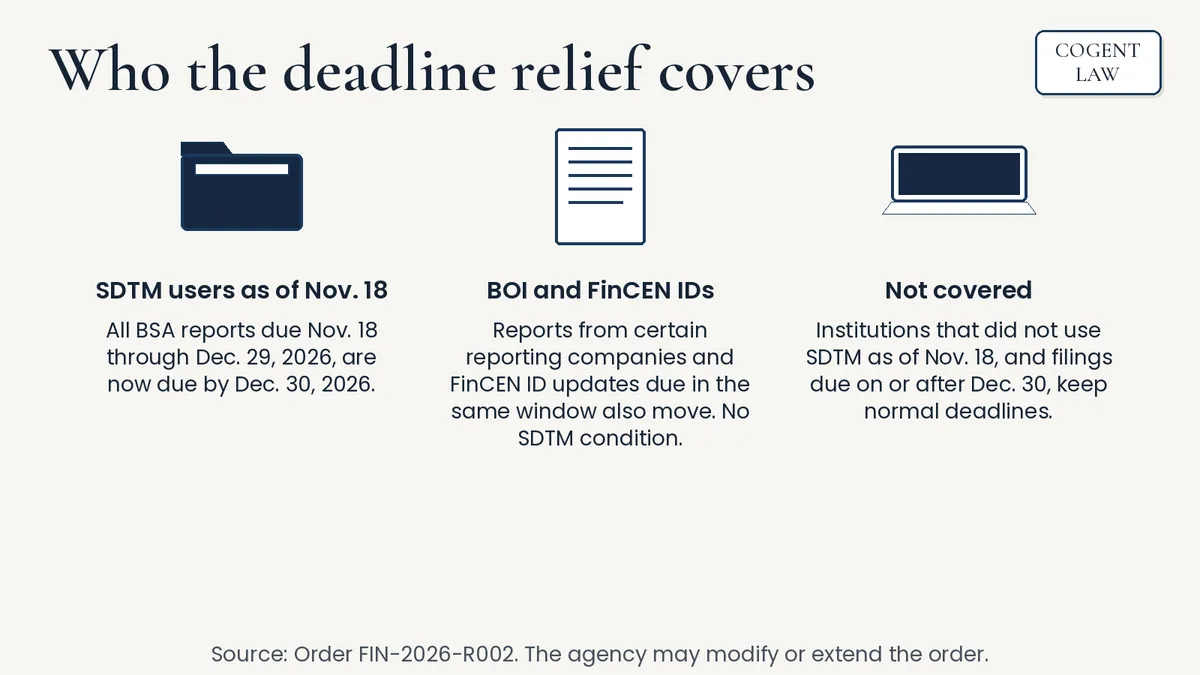
The order grants "temporary, limited exceptive relief" to any financial institution that, as of November 18, 2026, used SDTM, the batch-filing channel, to submit reports required under the Bank Secrecy Act and its implementing regulations. Reports those institutions would otherwise have filed from November 18 through December 29, 2026, are now due "no later than December 30, 2026." That includes suspicious activity reports (SARs), which the bank regulators' joint statement names.
Institutions that didn't use SDTM as of November 18, 2026, such as those submitting single reports on the website, fall outside this part of the order. Anything due on or after December 30, 2026, keeps its normal deadline. The agency "may modify or extend this order at its discretion."
Beneficial Ownership Reports and FinCEN ID Updates
The order's second part covers "certain reporting companies" required to file a BOI report and individuals required to update a FinCEN Identifier under 31 C.F.R. § 1010.380. Reports or updates otherwise due in the same window move to December 30, 2026. Unlike the first part, this one has no SDTM condition.
What the Order Does Not Change
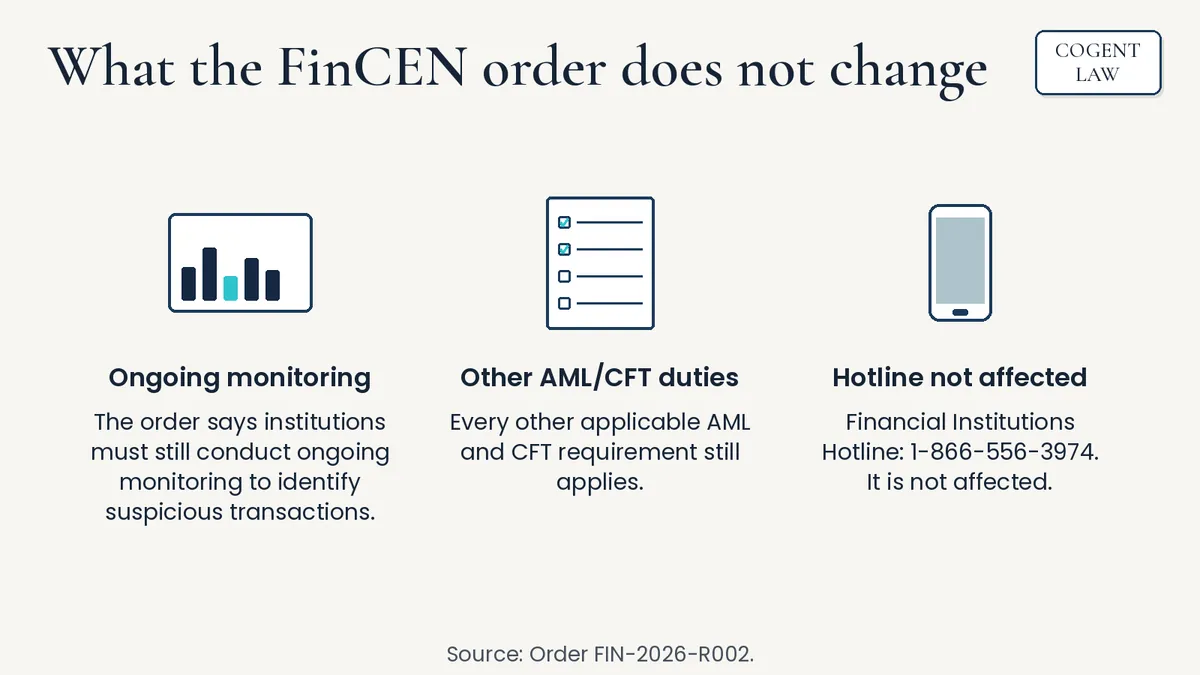
The deadline moved; the duty to monitor didn't. Institutions "must comply with all other applicable AML/CFT requirements," the order says, including "the obligation to conduct ongoing monitoring to identify suspicious transactions." Those that need to expedite the delivery of suspicious activity information to law enforcement agencies can call the Financial Institutions Hotline at 1-866-556-3974, which the order says "is not impacted by this service disruption."
Bank Regulators Pledge No Supervisory Action for SDTM Users
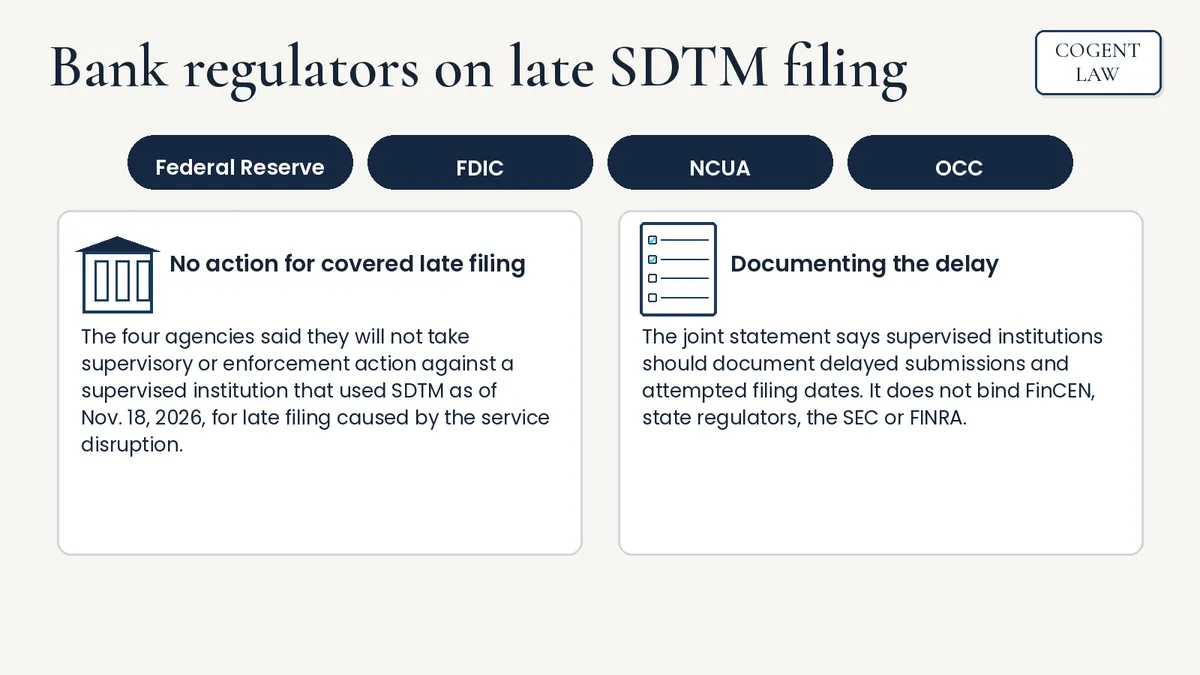
On November 25, 2026, the staffs of the Federal Reserve, FDIC, NCUA and OCC issued a joint statement of supervisory policy. The agencies said they won't take supervisory or enforcement action against a supervised institution that used SDTM as of November 18, 2026, "for late filing as a result of the service disruption." The statement adds that supervised institutions "should document" their filing issues, "including which submissions have been subject to delay and attempted submission date(s)."
It reaches only institutions those four agencies supervise and doesn't bind the bureau itself, state regulators, the SEC or FINRA.
What It Means for Money Services Businesses and Fintech Companies
Money services businesses (MSBs) that batch-file through SDTM appear to fall within the order's SDTM section, and so would a fintech company that is itself a covered financial institution and used SDTM as of November 18, 2026. Their covered reports would also move to December 30, 2026. The bank regulators' statement doesn't apply to MSBs or other companies those four agencies don't supervise. The order doesn't address whether a company filing through a vendor's SDTM connection counts as having "used" SDTM.
Practical Considerations
Steps businesses commonly consider include the following. The right approach depends on your facts.
- Confirming whether the institution used SDTM as of November 18, 2026, directly or through a vendor.
- Tracking which reports were delayed and when submission was attempted.
- Keeping transaction monitoring running while filings wait.
Counsel can help assess how the order and the joint statement apply to a specific reporting program.
Frequently Asked Questions
Which banks were hacked?
No source says any bank was hacked. The reported incident involved the agency's own systems.
How is the agency responding?
The agency took some systems offline as a precaution, extended certain deadlines to December 30, 2026, and, according to the official quoted by Reuters, is working with federal partners and outside examiners.
What information was accessed?
As of November 26, 2026, the government hadn't said what information or systems were accessed; the investigation was ongoing.
Contact Us Now
Questions about the December 30, 2026, deadline? Cogent Law's Banking and Financial Services team, including partner Chris Van Dyck, can help assess how the relief applies to your institution. Contact us or call 202-644-8880.
Related Practice Areas
Banking and Financial Services Law
Chartering, BSA/AML, bank-fintech partnerships, and examiner readiness.
Learn MoreMoney Transmitter License
State-by-state MTL, MSB registration, and ongoing compliance.
Learn MoreTalk to Cogent Law
Have questions about how this update may affect your business?
Questions about the December 30, 2026, deadline? Contact Cogent Law or call 202-644-8880.
Source
Order FIN-2026-R002 (November 24, 2026) · November 24, 2026
Read the original sourceSource confidence: High · Verified
Legal Disclaimer
This article provides general information only. It is not legal advice. Reading this article does not create an attorney-client relationship.