
Fraud in the Inducement: What It Is and How Businesses Handle It
Fraud in the inducement happens when one party lies about a material fact to get the other to sign a contract, and the deceived party signs believing the lie. The contract looks valid on paper, which is why these disputes are won or lost on drafting, timing and evidence gathered before anyone files anything. If you run a company in a regulated or fast-moving industry, the practical answer is to treat both sides of this issue as legal work: protect yourself in the contract you sign, and move quickly with counsel if you were misled. Our litigation and corporate attorneys handle both, and this guide explains the law the way we would walk a founder through it.
TL;DR
- Fraud in the inducement means a deliberate misstatement of material fact that led you to enter a contract. The contract is generally voidable, not automatically void.
- Courts typically require a false material statement, intent to deceive, reasonable reliance and damage. The exact wording and burden of proof differ by state.
- Merger clauses, non-reliance language and arbitration clauses can narrow or redirect a claim, so what you sign matters as much as what you were told.
- Remedies generally include rescinding the contract or recovering damages. Which one fits depends on your facts and your state.
- Act early: continuing to perform after you discover the lie can weaken a claim.
Table of Contents
- What fraud in the inducement means
- Fraud in the inducement versus fraud in the factum
- The elements a court looks for
- Why reliance decides most business cases
- When a fraud claim can sit next to a breach claim
- Arbitration clauses change where the fight happens
- Remedies: rescission or damages
- Where this comes up for high-growth companies
- A federal angle: Kousisis
- What to do if you think you were induced
- How we help
- FAQ
- Sources
What fraud in the inducement means
The doctrine is simple to state. According to Cornell’s Legal Information Institute, fraud in the inducement occurs when someone tricks another person into signing an agreement to their disadvantage using fraudulent statements and representations. The deception does not concern what the document says. It concerns the facts that made the deal look attractive: a counterparty’s finances, a product’s regulatory status, a license it claimed to hold, a customer pipeline that did not exist.
You will see the same idea written several ways: fraudulent inducement, fraud by inducement, fraud in inducement. Courts treat them as one claim. The Texas Supreme Court, for example, describes fraudulent inducement as a species of common-law fraud that arises in the context of a contract, which separates it from an ordinary claim that someone broke a promise.
Voidable, not void
The difference matters. A contract procured by this kind of fraud is generally voidable: the deceived party can choose to unwind it or keep it and sue for losses. The choice belongs to the victim. A party that learns the truth and keeps taking the benefits of the deal may be treated as having accepted it, so the decision should not drift.
Fraud in the inducement versus fraud in the factum
The two terms sound alike and lead to very different outcomes.
- Fraud in the inducement: you knew you were signing a contract, but you were lied to about facts that drew you in.
- Fraud in the factum (also called fraud in the execution): you were deceived about the nature of the document itself, for instance told you were signing a receipt when it was a loan guarantee.
The Alaska Supreme Court put it this way in a 2022 opinion: inducement concerns misrepresentations about a transaction’s risks, duties or obligations and generally makes a contract voidable, while factum concerns the essential nature of the document and may render it void. The Second Circuit, in its 2012 Leadsinger decision, described factum as reserved for rare cases where the deception goes to the very character or legal effect of the contract.
In commercial practice, almost every business dispute you will meet is inducement. Sophisticated parties read what they sign, so a claim that they did not know they were signing a contract rarely holds up.
The elements a court looks for
There is no single national test. Each state has its own formulation, and the differences affect how you plan evidence. Three examples show the pattern.
| State and court | What the plaintiff must show |
|---|---|
| New York (Second Circuit, 2012) | Material misrepresentation of present or past fact, intent to deceive, reasonable reliance, and resulting damages |
| Texas (Supreme Court of Texas, 2019) | Material misrepresentation, knowledge of falsity or reckless disregard of the truth, intent to induce reliance, actual reliance, and resulting injury |
| Virginia (Fourth Circuit, 2011) | Clear and convincing proof of a knowingly and intentionally false material representation, intent to mislead, reliance, and resulting damage |
Three features of these tests drive outcomes.
A statement of fact, not opinion or puffery. “We have 40 signed customers” is a fact. “We will be the market leader” is not. A forecast is usually not enough unless the speaker knew it was false when made.
Intent. You must show the speaker knew the statement was false, or in some states did not care whether it was true. Carelessness alone usually gives you a different claim.
Reasonable reliance. You have to show you believed the statement and that believing it was reasonable. This is where most claims by business parties are fought.
A classic example
The Second Circuit identified one familiar pattern: a party says it will honor the contract while knowing at signing that it will not. Picture a vendor that promises a compliance platform will be live and licensed in 90 days, while its own team knows the required state approvals have not been filed. If you sign and build your launch around that promise, the claim is not just that the vendor was late. It is that the promise was false when made.
Why reliance decides most business cases
The harder the parties negotiated, the harder it is to argue you were fooled. The Texas Supreme Court’s 2019 Mercedes-Benz USA v. Carduco decision held that reliance can be unjustified as a matter of law when the alleged inducement contradicts the unambiguous terms of the contract signed by a sophisticated party. In plain terms: if the contract says one thing and the salesperson said another, a company with lawyers and negotiating power will struggle to rely on the oral statement.
In the same year, in IBM v. Lufkin Industries, the court held that a merger clause alone (the clause saying the written agreement is the whole deal) does not bar a fraudulent inducement claim. A clear, unequivocal disclaimer of reliance on specific representations may bar it, depending on the contract language and the circumstances. The court looked at factors including:
- whether the terms were negotiated and the disputed issue was discussed;
- whether the parties had counsel;
- whether they dealt at arm’s length;
- their business sophistication; and
- how clear the release language was.
This is useful in both directions. If you are the buyer, you want the statements that mattered to you written into the agreement as representations and warranties, not left in a pitch deck or an email. If you are the seller, you want precise non-reliance language that a court will enforce. Either way, it is drafting work, and it pays off before a dispute exists.
When a fraud claim can sit next to a breach claim
Founders often ask whether they have to pick between “they broke the contract” and “they lied to get us to sign.” The answer depends on the state, but the pattern is consistent: courts try to stop double recovery for the same harm while letting a genuine fraud theory proceed.
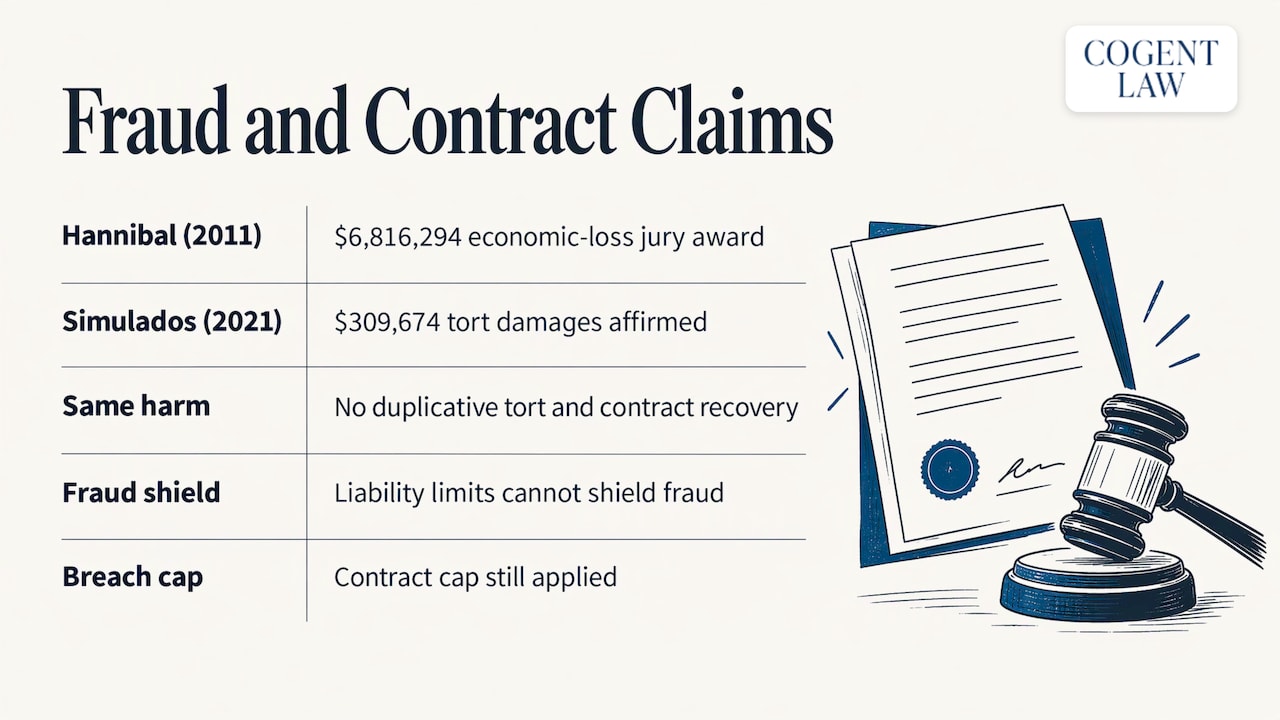
The Ninth Circuit, applying California law, has said the economic-loss rule does not bar tort recovery alongside a contract claim where the tort arises from intentional fraud. In Hannibal Pictures (2011) it affirmed a jury award of $6,816,294 in economic losses on that record. In Simulados (2021) it confirmed that a plaintiff may not collect duplicative tort and contract damages for the same wrong, though the plaintiff may elect the claim on which to recover. It affirmed $309,674 in tort damages in that case. The same opinion explains that California Civil Code section 1668 makes a liability limitation unenforceable to the extent it shields a party from fraud, while the contract’s liability cap still applied to the separate breach claim.
The takeaway for a board: a limitation-of-liability clause is not a guaranteed shield against a fraud allegation, and a fraud allegation is not a guaranteed way around a cap. Which side of that line a dispute lands on is a state-specific question.
Arbitration clauses change where the fight happens
If your contract has an arbitration clause, the first battle may be about forum, not merits. Under the U.S. Supreme Court’s Prima Paint decision (1967), a court may decide a challenge directed at the arbitration clause itself, while a claim that the entire contract was fraudulently induced goes to the arbitrator when the clause covers it.
That means a company that says “we were defrauded into this whole agreement” will often end up in arbitration, not in front of a judge, unless it can show the fraud targeted the arbitration agreement specifically. If that distinction matters to your deal, our guide to arbitration agreements for businesses covers how these clauses work and what to settle before you sign them.
Remedies: rescission or damages
The injured party generally has two paths. According to Cornell’s Legal Information Institute, because fraud negates the meeting of the minds a contract requires, the injured party can seek damages or terminate the contract. In sales of goods, the Uniform Commercial Code adds that remedies for material misrepresentation or fraud include all remedies available for ordinary breach, and that seeking rescission does not bar a damages claim.
In practice that gives you a decision to make early:
- Rescission: unwind the deal, return what you received and recover what you paid. This suits a transaction that has not gone far, such as a financing round or an operating agreement that has not yet shaped the business.
- Damages: keep the contract, or exit it, and recover your losses. This suits deals where you have already built on the other party’s performance and cannot realistically hand it back.
Whether punitive damages or fee-shifting are available varies by state and contract, so those questions belong with counsel who knows the forum.
Where this comes up for high-growth companies
The claim appears wherever a deal depends on facts you cannot verify yourself. Common settings for companies in regulated and emerging industries include:
- Investment and joint-venture deals, where a counterparty overstates revenue, licenses or approvals.
- Acquisitions, where a seller misdescribes liabilities, customers or compliance history.
- Vendor and platform agreements, where a provider claims capabilities or regulatory status it lacks.
- Entity formation, where founders are drawn into a venture on false statements. A Delaware Chancery decision, summarized in Google’s top results for this topic, has been discussed for allowing an entity to bring such a claim over statements made before it existed. Check the decision itself with counsel before relying on it.
The same logic works in reverse. If you are the one making representations in a pitch, a data room or a sales call, careless statements can later be framed as inducement. Disciplined disclosure is a risk control.
A federal angle: Kousisis
Fraudulent inducement is also a federal criminal theory. In Kousisis v. United States (2025), the U.S. Supreme Court held that federal fraud-by-inducement convictions may stand even when the victim receives the full economic benefit of the bargain, so long as the statute’s requirements for deception and for money or property as the object of the fraud are met. For businesses, the point is that a misleading statement made to win a contract can carry consequences beyond a civil suit. It is one more reason to keep sales and diligence statements accurate.
What to do if you think you were induced
These steps apply in most states, though timing and deadlines differ.
- Preserve everything. Emails, decks, call recordings where lawful, term sheets, drafts and chat messages. The claim turns on what was said before signing, so the earlier drafts matter.
- Compare the statements to the contract. Identify which representations made it into the agreement and which exist only in pre-signing communications. Look for merger and non-reliance language.
- Read the dispute clauses. Arbitration, forum selection, notice requirements and liability caps shape your options.
- Decide between unwinding and keeping the deal. Do not keep accepting benefits while you deliberate.
- Put the other side on notice through counsel, with a plan for evidence, forum and remedy.
How we help
Cogent Law’s attorneys come from large-firm and in-house backgrounds and focus on businesses in regulated and emerging industries such as fintech, cannabis, life sciences and energy. Our litigation and dispute resolution practice handles disputes like these, and our corporate and M&A team works on the contract side, where representations, disclaimers and dispute clauses are drafted. We offer upfront budgets and estimates, along with fixed-fee and hybrid arrangements, so you can weigh the cost of acting against the size of the problem.

If you are about to sign a deal that rests on statements you cannot verify, or you believe you already signed one, bring us the documents and the timeline through our practice areas page.
FAQ
What is the difference between fraud in the inducement and fraud in the factum?
Inducement means you were lied to about facts that persuaded you to sign a contract you understood. Factum means you were deceived about what the document itself was. Inducement generally makes a contract voidable, while factum may make it void, according to the Alaska Supreme Court’s 2022 opinion.
What must you prove for fraudulent inducement?
Most states require a false material statement, the speaker’s knowledge or intent to deceive, your reasonable reliance, and resulting damage. Some states, such as Virginia, require clear and convincing proof. Check your state’s formulation before you plan evidence.
Can a merger clause stop a fraud claim?
Not by itself in Texas, where the Supreme Court held in 2019 that a merger clause alone does not bar fraudulent inducement. A clear disclaimer of reliance on specific representations can, depending on the contract and circumstances. Other states have their own approaches.
What remedies are available?
The injured party can generally seek damages or terminate the contract. Whether you can recover both, and whether additional damages are available, depends on the state and the contract terms.
Does an arbitration clause apply to a fraud claim?
Often yes. Under Prima Paint, a claim that the whole contract was fraudulently induced goes to the arbitrator when the clause covers it, while a challenge aimed at the arbitration clause itself can be decided by a court.
Sources
- Cornell LII, Wex: fraud in the inducement
- Second Circuit, Leadsinger decision (2012)
- Alaska Supreme Court, Opinion No. 7632 (2022)
- Supreme Court of Texas, IBM v. Lufkin Industries (2019)
- Fourth Circuit, Persaud Companies v. IBCS Group (2011)
- Supreme Court of Texas, Mercedes-Benz USA v. Carduco (2019)
- Ninth Circuit, Hannibal Pictures (2011)
- Ninth Circuit, Simulados (2021)
- U.S. Supreme Court, Prima Paint v. Flood & Conklin (1967)
- U.S. Supreme Court, Kousisis v. United States (2025)
- Cornell LII, UCC 2-721: Remedies for Fraud