
KYC Requirements in the U.S.: What Regulated Businesses Must Do
Know your customer (KYC) is not one statute. It is a set of federal rules that tell a covered financial institution how to identify customers, verify them, understand the risk they bring and keep watching them. If you run a fintech, a crypto business or a company in another regulated industry, you may not be the institution the rules name, but your bank, your sponsor and your investors will hold you to them. Getting the structure right early is the cheapest compliance work you will do, and it is the kind of program design our FinTech, blockchain and cryptocurrency team builds with clients.
TL;DR
- KYC in the U.S. has three layers: the Customer Identification Program (CIP), customer due diligence (CDD) including beneficial ownership, and ongoing monitoring with suspicious activity reporting.
- The CIP and CDD rules apply directly to banks, credit unions, securities brokers, mutual funds and futures intermediaries. Fintechs usually meet them through a bank partner’s contract terms.
- Beneficial ownership means every individual owning 25% or more of a legal entity customer, plus one control person.
- FinCEN is reshaping parts of the framework in 2026, so build a program that can adapt rather than copy a template.
Table of Contents
- Who the U.S. KYC rules apply to
- Layer one: the Customer Identification Program
- Layer two: customer due diligence and beneficial ownership
- Layer three: ongoing monitoring and suspicious activity
- What changed in 2026
- How fintechs should build a KYC program
- Where counsel fits
- FAQ
- Sources
Who the U.S. KYC rules apply to
The rules come from the Bank Secrecy Act and the USA PATRIOT Act and are enforced by FinCEN, the Treasury bureau that writes anti-money laundering (AML) rules, together with the banking agencies. FinCEN’s CDD Rule FAQs say the covered financial institutions are federally regulated banks and federally insured credit unions, mutual funds, securities brokers or dealers, futures commission merchants and introducing brokers in commodities.
If you are a money services business (MSB), such as a money transmitter, the picture differs. Industry best practices state that the CDD Rule does not currently apply to MSBs, and that banks are not expected to act as their de facto regulators. MSBs still carry their own AML program duties, and the banks that hold their accounts will ask for evidence of how they identify customers. Our overview of MSB registration fundamentals covers that starting point.
The practical takeaway: even when a rule does not name you, your KYC program is judged against these standards by the institutions you depend on.
Layer one: the Customer Identification Program
The CIP rule implements section 326 of the USA PATRIOT Act. Under 31 CFR 1020.220, a bank must have a written CIP, as part of its AML program, with risk-based procedures to:
- Collect identifying information before opening an account: name, date of birth for individuals, address and an identification number. For U.S. persons that is a taxpayer identification number. For non-U.S. persons it can be a passport number, alien identification number or another government-issued photo document number.
- Verify identity within a reasonable time after opening, using documents, non-documentary methods or both.
- Keep records for five years.
- Compare customers against federal terrorist lists.
- Give customers adequate notice that the bank is requesting identity information.
The joint agency FAQs stress that the four data points are a floor, not a ceiling: a bank must add risk-based verification that reflects account types, how accounts are opened, and its own size, location and customer base. They also note that a CIP alone does not satisfy a bank’s other BSA, SAR or OFAC obligations.
What documents verify a customer
The same rule lists acceptable evidence. For an individual, documentary verification can use an unexpired government-issued photo ID such as a driver’s license or passport. For a corporation, partnership or trust, it can use certified articles of incorporation, a government-issued business license, a partnership agreement or a trust instrument. Non-documentary methods include contacting the customer, comparing data with a consumer reporting agency or public database, checking references with other financial institutions and obtaining a financial statement.
The rule also requires procedures for when verification fails: when not to open the account, when to close it, and when to file a Suspicious Activity Report.
Relying on a partner to run CIP
Bank-fintech programs often split the work. The rule lets a bank’s CIP include reliance on another financial institution, including an affiliate, if the reliance is reasonable, the other institution is federally regulated and subject to an AML program rule, and it signs a contract certifying annually that it has implemented its AML program and will perform the specified CIP steps. If your model depends on this arrangement, the contract language matters as much as the onboarding flow. We discuss the dynamic in reflections on bank-fintech relationships.
Layer two: customer due diligence and beneficial ownership
CIP answers “who is this?” CDD answers “who is behind it, and what will they do with the account?” FinCEN describes CDD as identifying and verifying beneficial owners, understanding the nature and purpose of the relationship, and ongoing monitoring.
A beneficial owner has two prongs, per the consolidated CDD FAQs:
- Ownership: each individual who directly or indirectly owns 25% or more of the equity of a legal entity customer.
- Control: one individual with significant responsibility to manage or direct the entity, such as a CEO, CFO, COO, managing member, general partner, president, vice president or treasurer.
That gives every entity between one and five beneficial owners. If you are a startup opening business accounts, expect your bank to ask for exactly this information, so your cap table needs to be clean before you apply.
Worked example
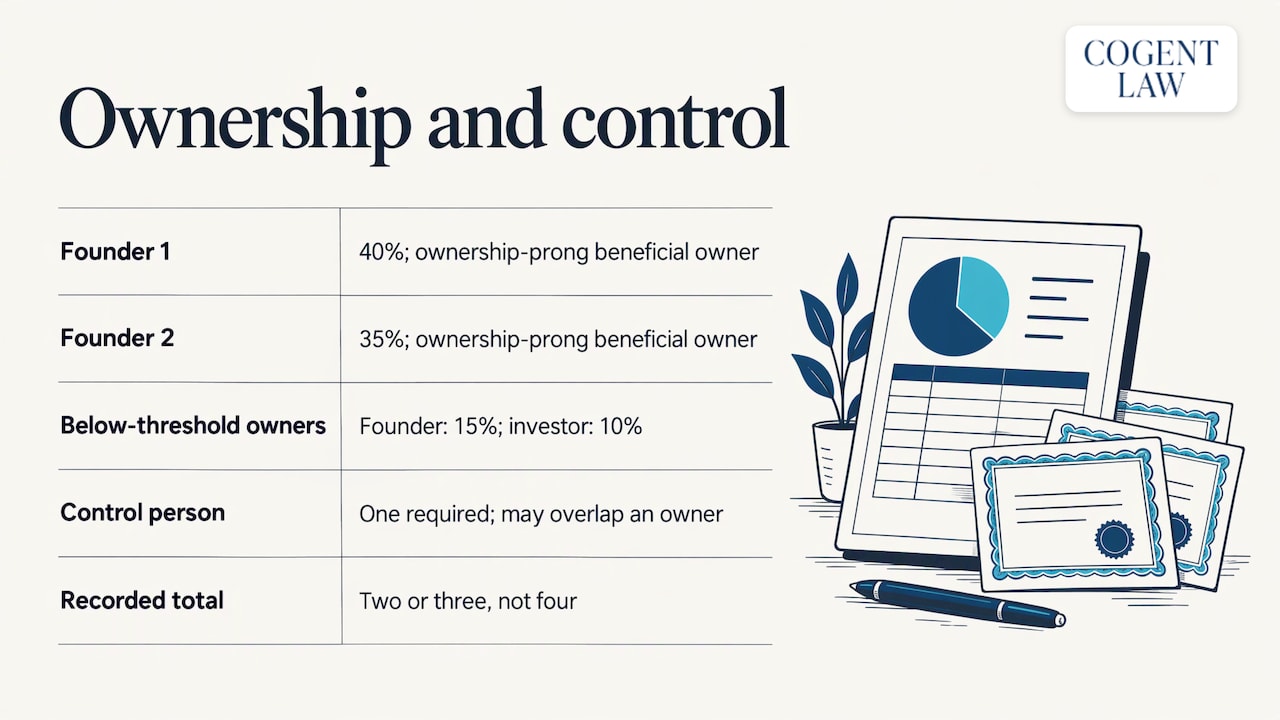
Suppose a startup has three founders holding 40%, 35% and 15%, and an investor holding 10%. The first two founders are beneficial owners under the ownership prong. The third founder and the investor fall below 25%. The bank must also collect one control person, who could be the CEO, who may also be one of the 25% owners. The bank would therefore record two or three individuals, not four.
Exemptions
Some customers are excluded from beneficial ownership collection, including companies whose common stock is listed on the NYSE, NYSE American or NASDAQ, and U.S. entities at least 51% owned by such a company. Companies listed only on foreign exchanges are not excluded. FinCEN also lists four account categories that are exempt, among them point-of-sale retail credit accounts up to $50,000. The exemptions do not reach accounts that allow third-party payments or cash refunds. All of this appears in the CDD Rule FAQs.
Records
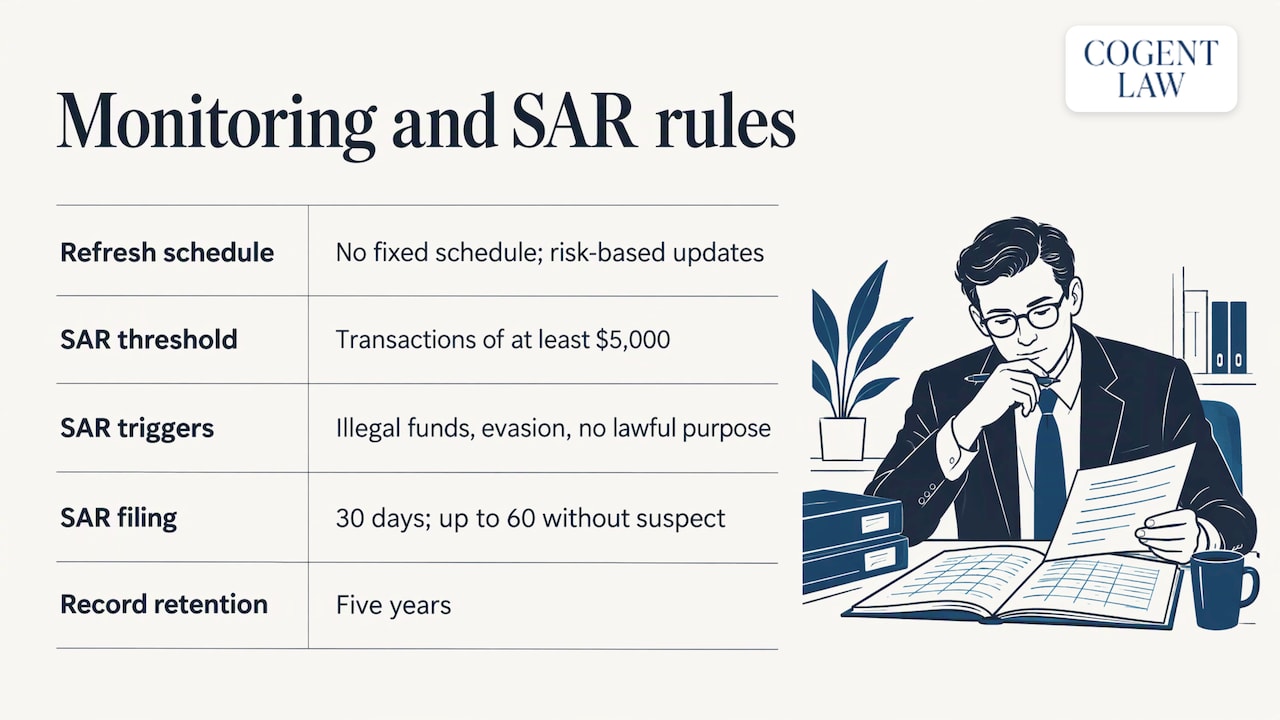
Under 31 CFR 1010.230(i), beneficial ownership records, including the certification form or its equivalent, are kept for five years after the account closes. Verification records, such as the documents relied on and how discrepancies were resolved, are kept for five years after they are made.
Enhanced due diligence
Higher-risk relationships get more scrutiny. The same part of the regulations requires due diligence programs for foreign correspondent accounts and private banking accounts, including identifying nominal and beneficial owners, checking for senior foreign political figures, and understanding the source of funds and expected use of the account.
Layer three: ongoing monitoring and suspicious activity
The bank AML program rule, 31 CFR 1020.210, requires internal controls, independent testing, a designated compliance officer, training, and risk-based procedures for ongoing CDD. That includes building a customer risk profile and monitoring to detect and report suspicious transactions.
FinCEN is explicit that there is no categorical requirement to refresh customer information on a fixed schedule. Updates are risk-based and triggered by monitoring, though an institution may choose periodic reviews.
When monitoring turns something up, the bank SAR rule at 31 CFR 1020.320 applies. A bank files a Suspicious Activity Report for transactions of at least $5,000 that it knows, suspects or has reason to suspect involve illegal funds, are designed to evade BSA requirements, or have no apparent lawful purpose. The filing is due within 30 calendar days of initial detection, or up to 60 if no suspect is identified, and records are retained for five years.
What changed in 2026
Two developments matter for planning:
- Beneficial ownership at onboarding. On February 13, 2026, FinCEN issued an order that lets covered institutions identify and verify beneficial owners at first account opening, when the reliability of earlier information is in doubt, and as needed under risk-based ongoing CDD, instead of at every new account. The CRS report on FinCEN confirms the relief and its legal basis.
- Program-level reform. FinCEN’s April 10, 2026 proposed rule would substantially reform AML/CFT program requirements. A November 19, 2026 Federal Register notice on CDD addresses the certification form: institutions may use the standard form in Appendix A to 31 CFR 1010.230 but need not, and when relying on a prior certification they must get confirmation from a representative that it is current and accurate.
Proposals can change before they become final. Our notes on the AML modernization proposal and the proposed CDD changes track the details.
How fintechs should build a KYC program
A workable program for a high-growth company follows the same order the rules do.
- Map your regulatory status. Are you a bank, an MSB, a broker, or a nonbank working through a sponsor? That determines which rules bind you directly and which arrive by contract. Licensing is part of the same map: see our guide to money transmitter licensing.
- Write the CIP-style intake. Collect the four identifiers, define documentary and non-documentary verification, and set what happens when verification fails.
- Add beneficial ownership for entity customers. Use the 25% and control-person test, and keep the certification and verification records.
- Tier your customers by risk. The five federal agencies’ joint statement says no customer type presents uniform risk, and that banks complying with BSA/AML requirements are neither prohibited nor discouraged from serving any class of customer. A documented risk model is what lets your bank partner say yes.
- Set monitoring and escalation. Define what triggers a review, who decides, and how a suspicious activity referral reaches the bank or the filing function.
- Protect the data. Identity documents are among the most sensitive records you hold. Guidance on cybersecurity essentials for finance firms is a good complement to your KYC controls.
- Keep records for five years and make them retrievable for examiners and bank audits.
The legal judgment sits in steps 1, 4 and the partner contract. Whether a rule applies to you, how a bank agreement allocates CIP duties, and whether your risk tiers will survive an examination are questions where an error is expensive.
Where counsel fits
Cogent Law advises companies in fintech, blockchain and cryptocurrency, banking and financial services, and cannabis on money transmitter licensing, regulatory and AML compliance. Our attorneys have large-firm and in-house experience, and we offer upfront budgets and estimates plus fixed-fee and hybrid arrangements, so a KYC program build can be scoped before work starts. We also connect clients with banks, investors and advisors. You can see the full list of practice areas.

If your bank partner has sent a diligence questionnaire, or you are preparing a license application, start with the FinTech, blockchain and cryptocurrency practice.
FAQ
What is the difference between KYC, CIP and CDD?
KYC is the everyday term for the whole process. CIP is the identification and verification step required when an account is opened. CDD adds beneficial ownership, an understanding of the relationship’s purpose and ongoing monitoring.
Do fintech companies have to follow KYC rules?
It depends on your status. Banks, broker-dealers and similar institutions are directly covered. MSBs are outside the CDD Rule but have their own AML obligations, and nonbank fintechs typically meet KYC standards through their bank or sponsor agreements.
How often must customer information be updated?
There is no fixed schedule in the federal rules. FinCEN says updates are risk-based and driven by ongoing monitoring, although an institution can choose periodic reviews for higher-risk customers.
Who counts as a beneficial owner of a company?
Every individual who directly or indirectly owns 25% or more of the entity, plus one individual with significant control responsibility. An entity therefore has between one and five beneficial owners.
Sources
- CDD Rule FAQs, FinCEN
- 31 CFR 1020.220, Customer Identification Program for banks
- Ten of the Most Common Questions about the Final CIP Rule
- CDD Rule Consolidated FAQs
- 31 CFR Part 1010, General Provisions (2025 CFR)
- 31 CFR Part 1020 (2025 CFR)
- MSB Best Practices
- Joint Statement on the Risk-Based Approach to Customer Due Diligence
- CRS report R47255 on FinCEN
- FinCEN proposed AML/CFT program rule, April 10, 2026
- Federal Register, Customer Due Diligence Requirements for Covered Financial Institutions
- Cybersecurity essentials for finance firms